Samples of Work
Reporting & Writing
I joined my school’s newspaper class as a reporter. It has been the foundation for everything I have done journalistically. I have continued to report on many stories since my sophomore year and I have expanded into writing opinion and review pieces. Being a reporter has made me improve my grammar, writing (not just journalistically) and ability to research. I have applied these skills outside of the newsroom and have seen personal growth as a student in other aspects of school.
This story shows my ability to write an opinion piece. I stated my opinion clearly in the lead in the first paragraph, so my audience immediately knew what direction I was going with in this story. In the body of the story, I use quote-tranistion-quote format well and use facts and information from a police officer to back up my opinion. I also made sure to mention an opposing viewpoint, but refuted it. I overall think that this is a well-structured opinion piece.
Here, I worked on identifying the challenge in my writing, and this story displays that. To make a more emotional story, I identified the challenges of the ballet school losing six people and the hardships of being a smaller dance studio. I also included information on how the people in this story overcame these challenges. By putting this in, the readers are left satisfied knowing that there is a solution to the problems. Overall, identifying a challenge helped this piece of writing stay on the angle and made it easy to read.
As someone with a strong interest in music, I was passionate about the topic, which made the story easier and more motivating to write. This story is important to students as it covers an issue many have dealt with. I have facts and statistics to support and explain the angle of my story. I wrote this story in my junior year when I became more comfortable with writing longer stories. Sometimes, when writing longer stories, it can become easy to almost go in circles and say the same thing in different ways to reach the word count. I had plenty of points to follow that all related back to the angle.
Editing
At the end of my sophomore year, I became a section editor and started working with about two reporters each issue to edit their stories. When I became EIC at the end of my junior year, I was tasked with editing stories for the whole class. I also became a design editor and was tasked with having to edit all of my section editors’ spreads.
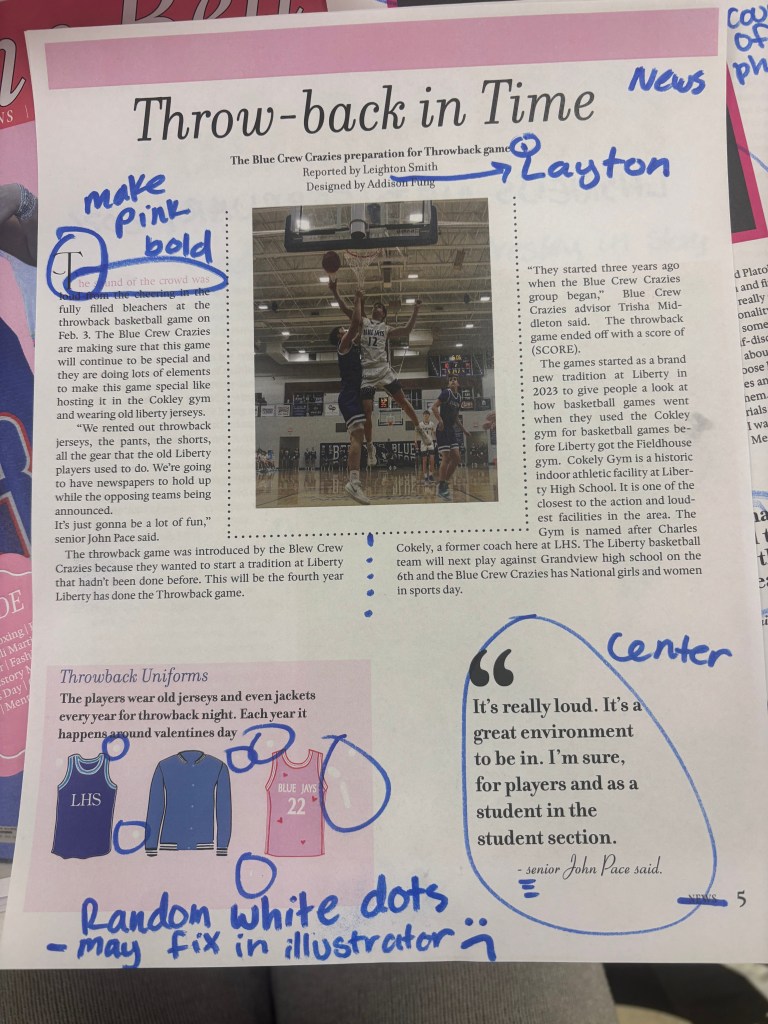
Here is a recent design I edited. Since I am the one who came up with our theme and constants for our paper this year, I make sure to look for those elements first, so that our whole paper is cohesive. For example, the top right corner should have the section title. The bottom right corner also needed our website link, and the month and year. Another element that I have for all pages is that the first line of copy is bolded, and my section editors can change the color if they wish. I made a note to bold the pink, since it was hard to see, and the rest of the paper has bold first lines of copy. I also suggested centering her pulled quote, since I usually like right-aligned or left aligned quote when it is aligned next to a photo, text, etc.
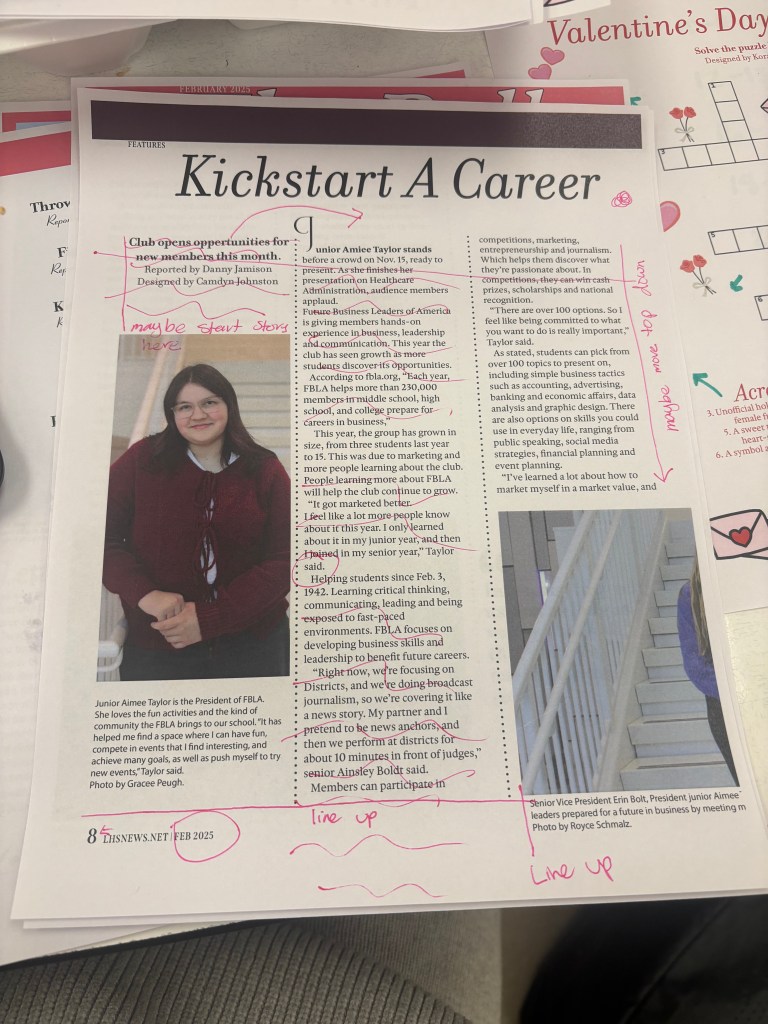
Here, I believe this section editor was having a challenging time getting everything to fit on her page. Some of my edits here are to help her with that, and to lay out everything more clearly. I suggest that she bring down the columns of text a bit while also making sure the column of text, caption and photo are all lined up evenly on the bottom. Her subhead and bylines were also off to the side, and in our paper, we centered them under the title. It also looks a bit confusing, being on that left-hand side, and at first glance, it looks like the start of the story. I suggest that if she moves everything, she will have room to move the subhead and bylines centered below the title, and she can put the first part of her story above the first photo, giving more room for copy.
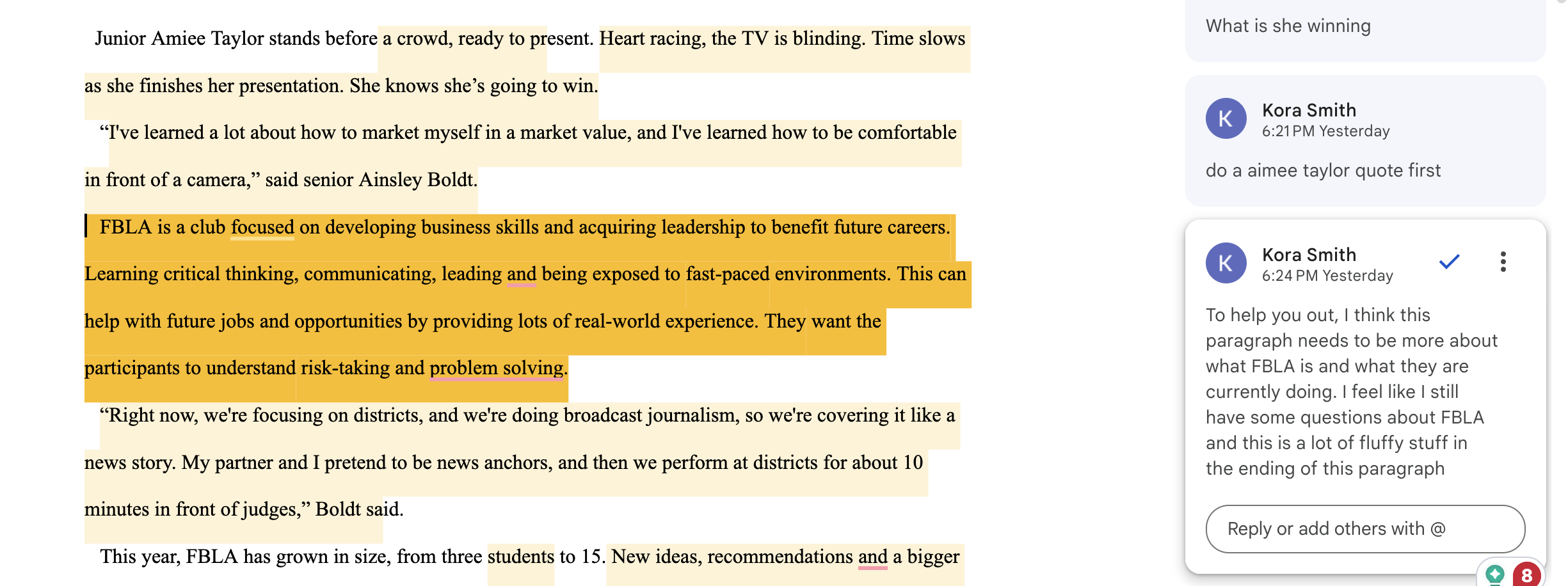
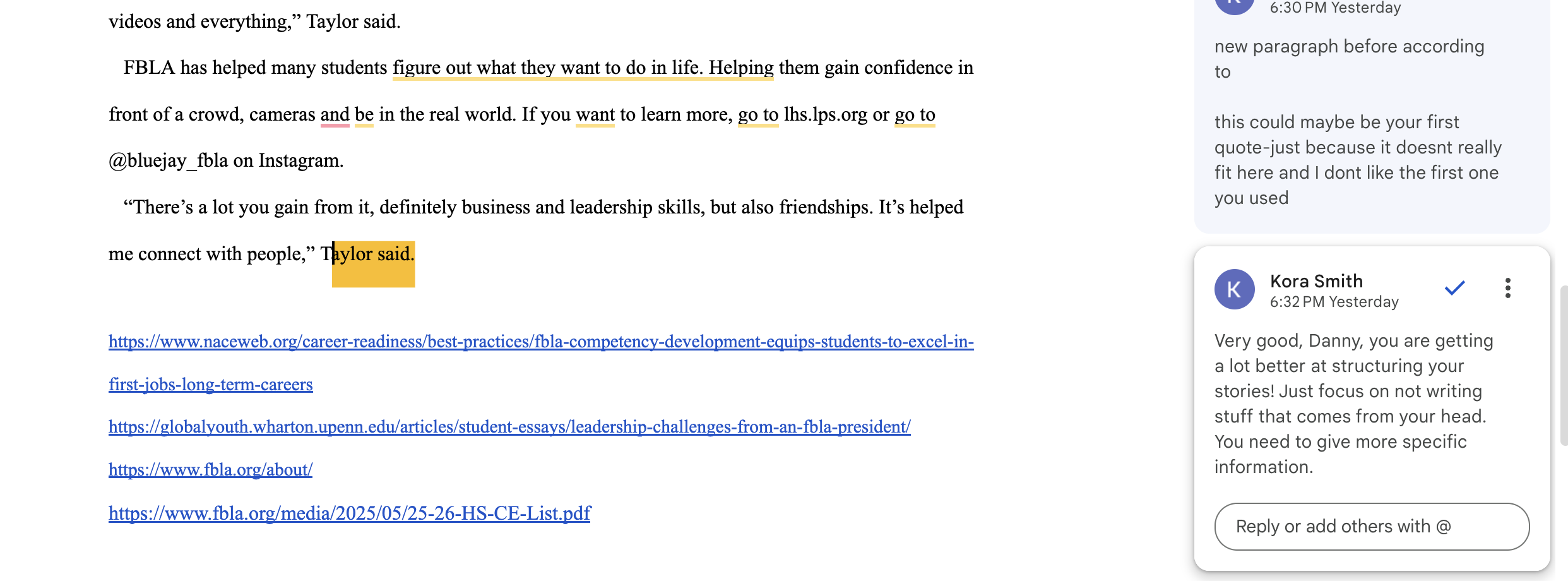
Above are some of the edits I made to a reporter’s story. Rather than only correcting grammar and formatting issues, I like to give ideas on what to add to the story. I could just say “This story is under wordcount,” and leave it to the reporter to figure it out, but I like to help them reach that word count. Instead, I give feedback and ideas on what should be in the story. Even if the issue isn’t word count, sometimes the angle isn’t getting across, and I like to help with that. This is important so the reader doesn’t have any questions that are left unanswered. I also make sure to give compliments throughout editing stories to keep my reporters motivated. At the end of stories, I always make a point to leave a comment on the story as a whole. I give a compliment for the overall story and some overall suggestions that they can apply to their current story, and think about the next time they write.
Here is the before of a story I edited. The next file is after the edits were made.
Design
I started working on InDesign at the end of my sophomore year and became a section editor at the start of my junior year. At first, the battle with InDesign was tricky, but now I find myself able to make all the elements of design come to life on my pages.
What stands out about this design is its uniqueness. In our paper, we don’t typically use a black background with white text, but instead a white background with black text. I experimented with the black background to make an eye-catching design for this issue. This differentiation is good for our paper; the readers can see a variety of designs throughout the paper and the issues. It is more interesting than the designs that look almost the same. I also displayed a good use of a dominant on this page, which would be the girl that the story is about, on the left of the page.
When I became EIC, I spent the summer before my senior year looking for professional design inspirations for the coming year’s paper. After finding inspiration, I was able to create the paper, including the TOC that is above. It contains plenty of information without looking too crowded. I also used a good hierarchy with the dominant being the big photo on the right-hand side. Next, the reader’s eye will go to the stamp that explains the cover, since that is also of importance. Overall, it looks professional, put together and creating templates for the whole paper gave me a deeper level of knowledge on InDesign.
This is one of my designs from my junior year. This design displays my work on Adobe Illustrator. The overall design is supposed to look like it came out of a notebook, so I fully illustrated a scrapbook-like mod for the right-hand corner. The notebook binding in the middle was also designed by me. It was a challenge to figure out some parts of Illustrator since I was a bit new to it at the time, but playing around with it on this design has helped me gain knowledge and now it is not as much of a hassle to use Illustrator. These notebook-like elements also help the design achieve cohesiveness on the page, making it easy on the reader’s eyes.
Other Samples of Work
The only journalism class I have taken is newspaper, so I have a strong focus on reporting and designing. All of the jobs I have had on staff have also only revolved around reporting, desiging and editing. I have dabbled with photography in my time on staff, and I haven’t experienced broadcast media. Photography and broadcast journalism are areas of improvement for me and I plan on exploring them more in the future.
Broadcast journalism
I feel this is an area of journalism that I haven’t explored much, nor do I have much experience in it. For me, this is an area of improvement for the future and something that will be explored more. Here is a commercial I did for my internship, where I was able to get the experience of being on set and behind a camera.
Photojournalism
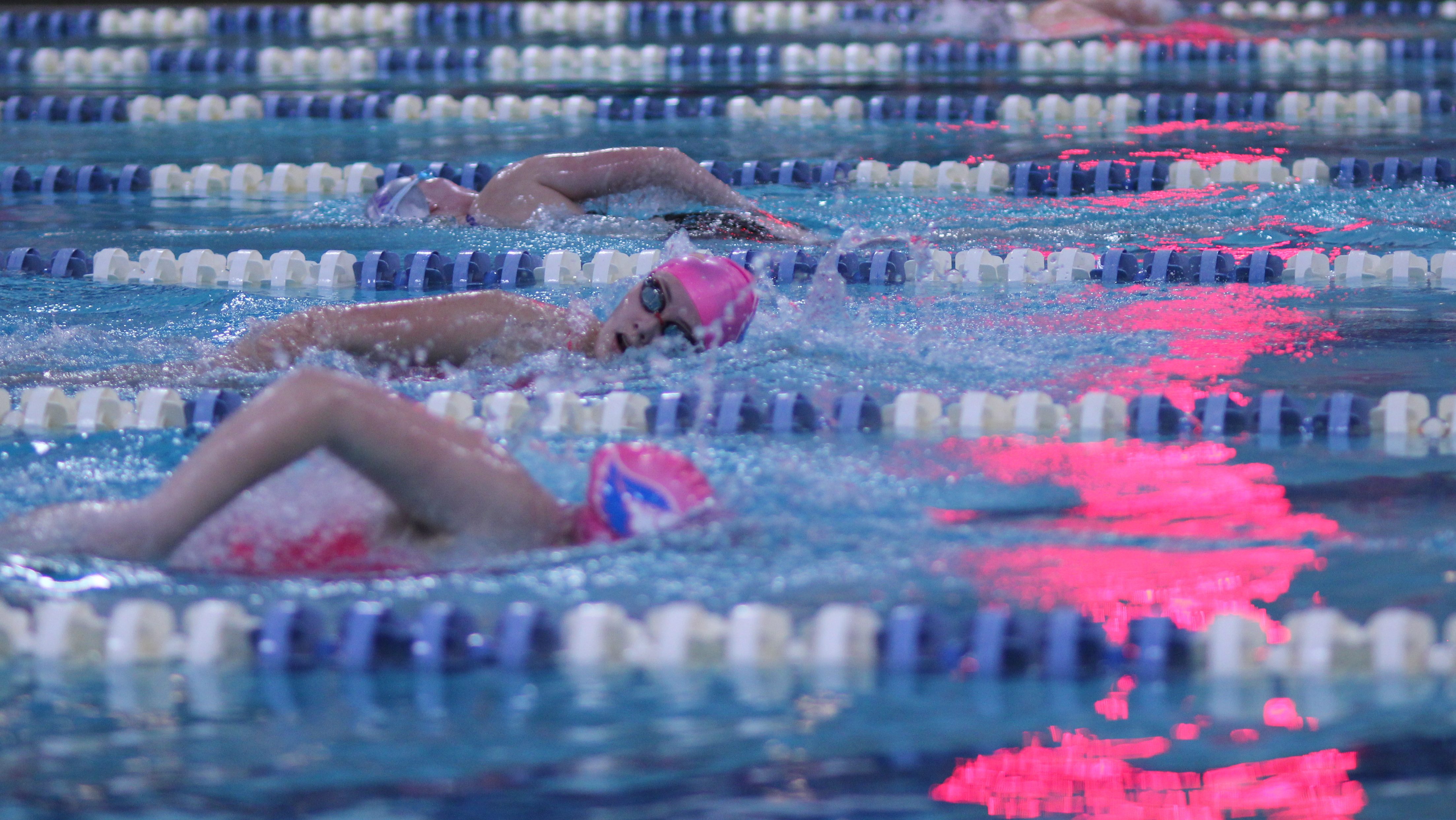
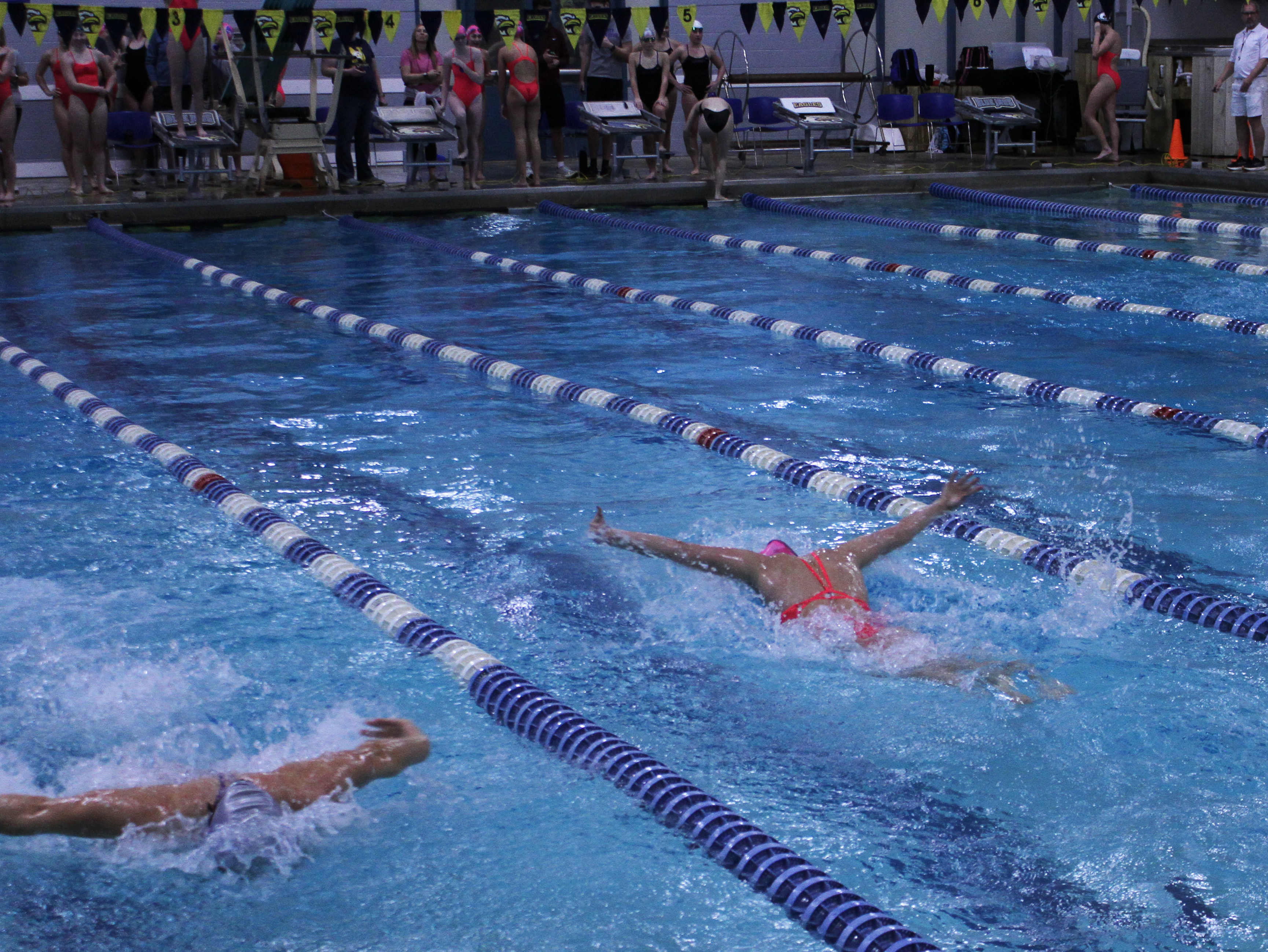
These swim photos were a successful but challenging set for me to take. I managed to get the water nice and crisp-looking in the photos rather than just blobs of grain. It is easy to get swim photos that are blurry and not timed right. The first photo is nice since you can see the swimmer’s face, which would be important to the pages in our paper, so that we can showcase the students. The second photo has the swimmer in the rule-of-thirds and showcases where the swimmer is going.
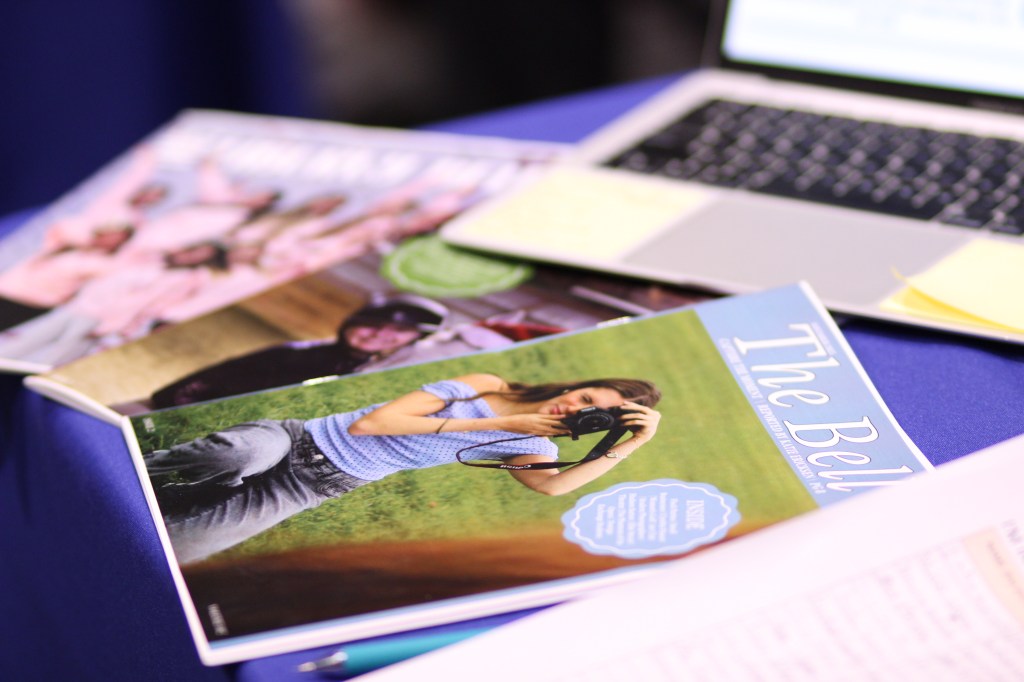
In this photo, I tried to achieve a shallow depth of field. This is because I wanted to highlight and isolate the subject of the photo, which is the magazine in the front. A shallow depth of field works best for this photo since the scene I am photographing isn’t very big. It is already and up close shot, so a small depth of field is fitting.

Web & Social Media
After scanning this QR code, you will a social media post I have created for our Instagram. It covers a basketball game/event at our school, while also appealing to a trend. The reel also highlights staff members and gives our audience a chance to get to know them better. It also gives an insight into what it is like being on our staff, maybe encouraging other students to join in the coming years. I also made sure to bring attention to the basketball team and spirit leaders who made this event happen.
Leadership
Leadership & Team Building
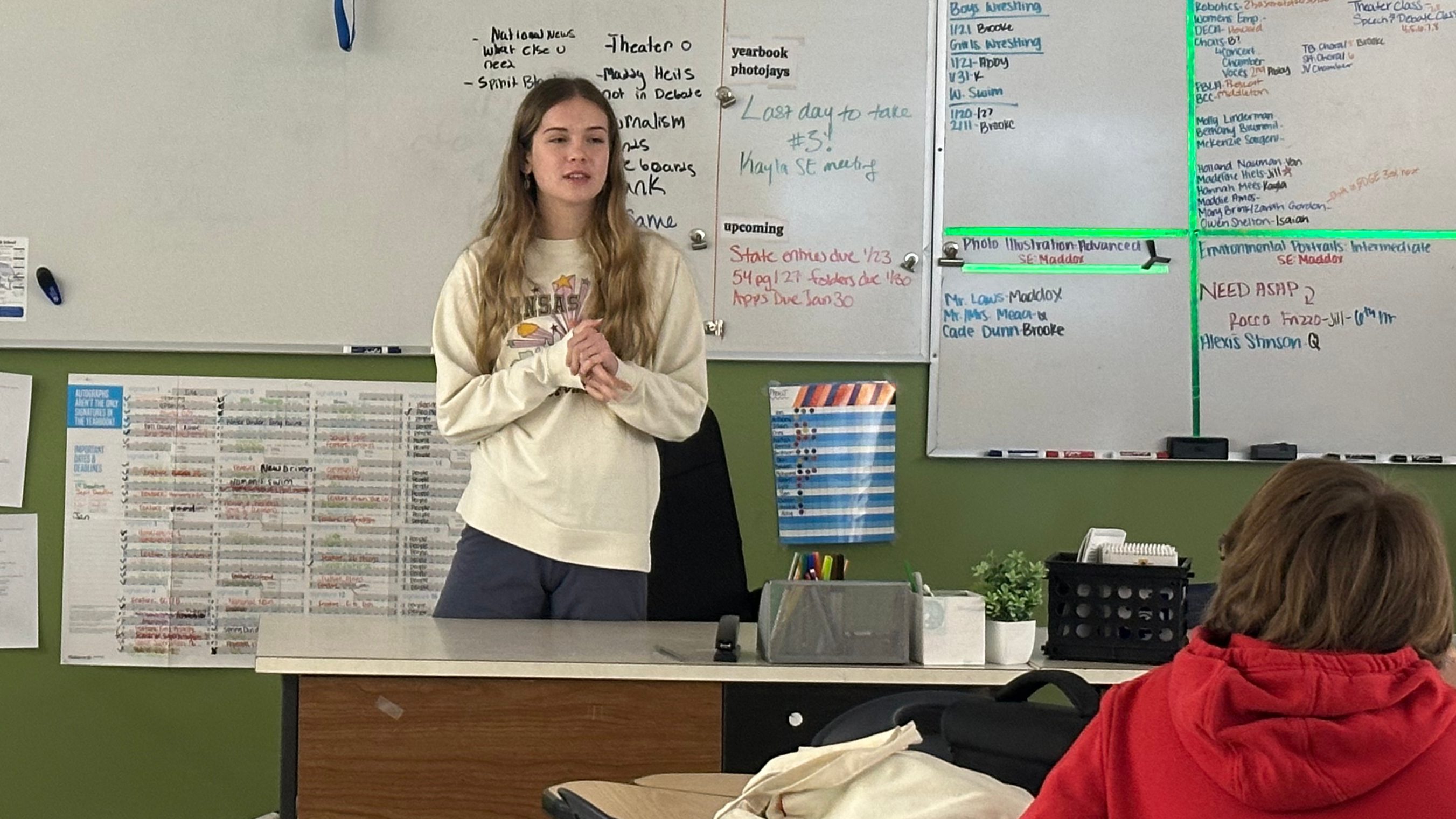
Journalism has given me a greater insight into leadership than anything else in my life. I started a smaller leadership role at the end of my sophomore year and was given the greatest leadership role, EIC, at the end of my junior year. EIC has given me the task of starting class every day, being in charge and being a source of help for my classmates. When I started my journalism internship, I knew I had these leadership qualities and decided to ask my advisors to step up and be a student editor. As of now, I am the only student editor for my internship, but I hope that I have led the way for others to want step up as well. Read my self-analytical essay to get a bigger insight into what leadership and journalism have done for me.
Communication
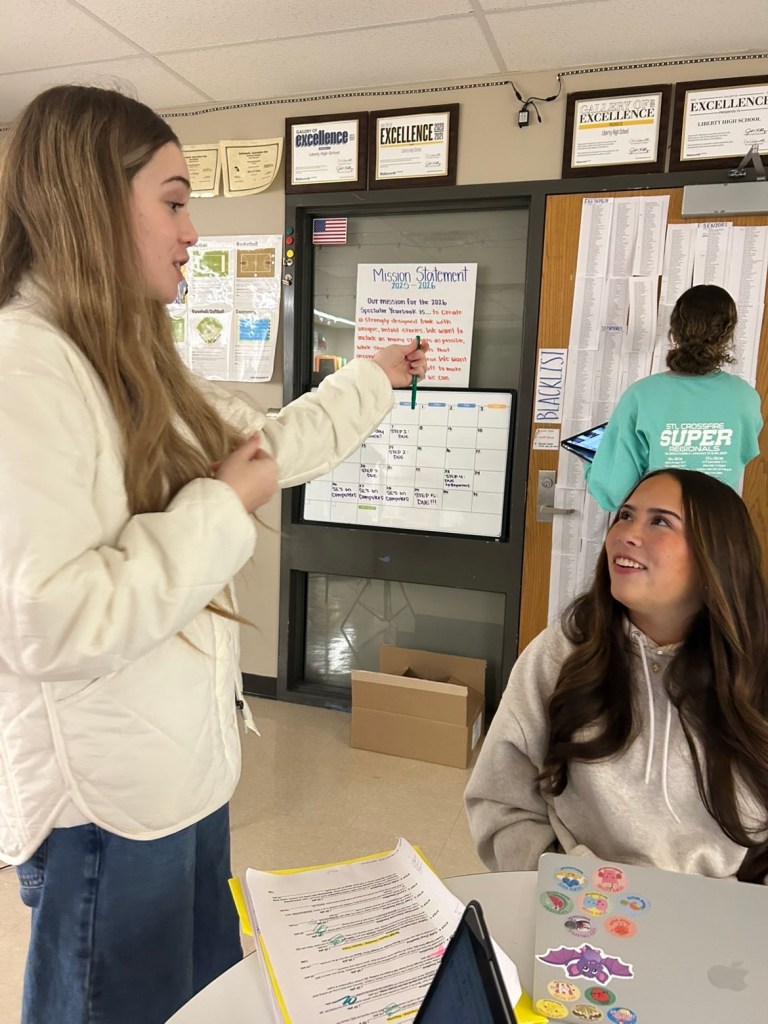
I believe that communication amongst editors, reporters and photographers is of utmost importance in a publication. It is a goal of mine to go around to each person every day to check in with how they are doing. This helps me see where they are at and gives them an opportunity to ask questions. It also helps them stay on task, knowing that I expect to see progress each day. I also encourage section editors to sit next to their reporters and visit with our photo managing editor so that everyone is on the same page. We do this by using a folder that hold eveyrthing required for that story. Each deadline, the front of the folder must be signed by either me, a section editor, or our photo managing editor, to encourage communication.
Deadline Nights and Hangouts
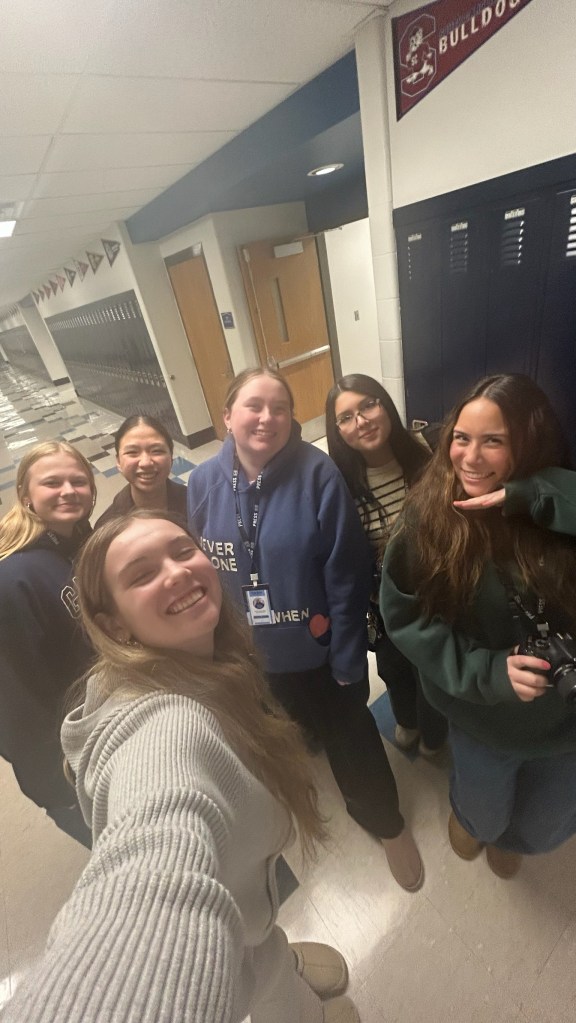
At the final deadline for each issue, we all stay after school to catch up and finalize stories and designs. This is what we call deadline night. Not only do we get our work done, but we also have a chance to hang out and socialize with our peers. After deadline nights, we sometimes leave to go to the library, Starbucks, or do other activities. This helps build friendships throughout the class since it is easier to work with people you are comfortable with.
This is an example of a time I had to communicate with my peers. I expressed to the photographer who was photographing my mod what I wanted. Since the angle of the story was a volleyball player getting a new personal record, I wanted a mod of other students with PR’s, so that I could get more students in our paper. I made a trip down to the weight room with my photographer so that we could figure out what students had school records. Later, when she went off to take the photos, I made sure to communicate to her that she also needs to ask them and write down what the exact numbers of their PR’s were. That way, I didn’t have to bother asking them later, and we got my mod done efficiently.
Law & Ethics
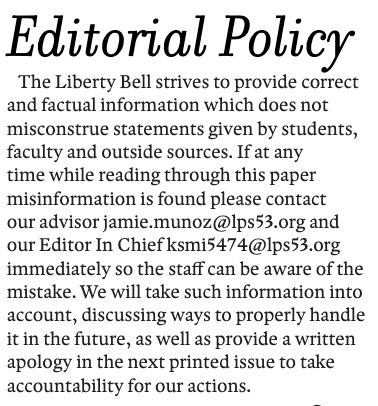
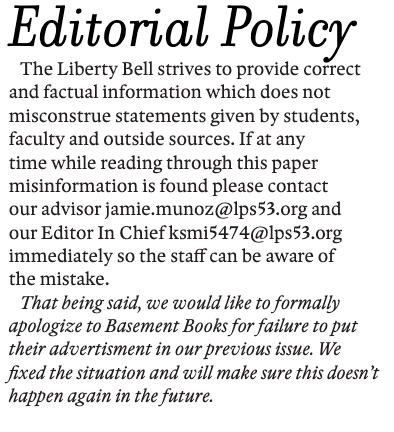
Each year, we study the laws and ethics of journalism and craft a mission statement based on what we have learned and what we value. We honor the laws of journalism by seeking truth and reporting it, meaning we hunt for the story and don’t sway information or quotes. We act independently by avoiding bias and opinion. We minimize harm by not degrading our students in our stories and we are respectful during interviews, avoiding private and sensitive matters. Lastly, we will always remain accountable. During our first issue, we inadvertently omitted an advertisement that was intended to be included in the issue. Since our editorial policy states that we will provide a written apology when a mistake is made, we followed through. In our next issue, we wrote an apology for the mistake, because as journalists we must remain transparent.
Our editorial policy
My written apology
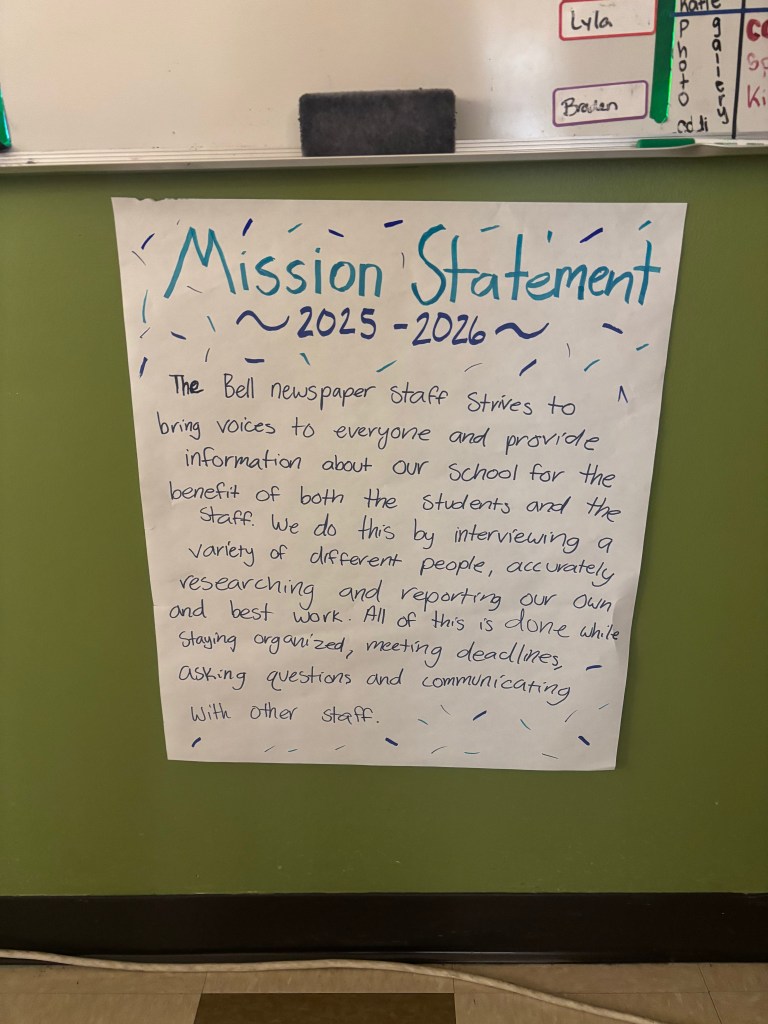
My team created this mission statement. I finalized it and hung it up in our classroom as a reminder of what we stand for.
News Literacy
In 2024, my class took a field trip to the KC Star. They met with various staff members, but what stuck out the most to me was the advice Executive Editor Andale Gross gave us. Upon asking what advice he would have for young journalists, he said, “In order to have good writing, you have to read good writing.” He explained that the best way to learn to write journalistically is to read professionals’ work every day and become familiar with the structure and credibility. This stuck with me. Since then, I have followed The KC Star, The New York Times and more on social media. I find myself reading journalistic articles in my free time as much as I can. I even have a subscription to get Rolling Stone magazines delivered to my house each month. It is important to read the news because of the credibility it has and the truth it shares. Reading professional stories and seeing how and where they get their facts can be applied to student writing.
Above is an example of mine that showcases unbiased reporting. As a reporter, it was my job to share about the event, not to give my opinion or support the movement that was happening. I also didn’t partake in the walkout, since I made the decision to report on the story, I had to be completely neutral and involved in this situation. In my article, the only part that showcases a stance on the event comes from the quotes, as that is the only part that can show emotion.
Marketing & Audience
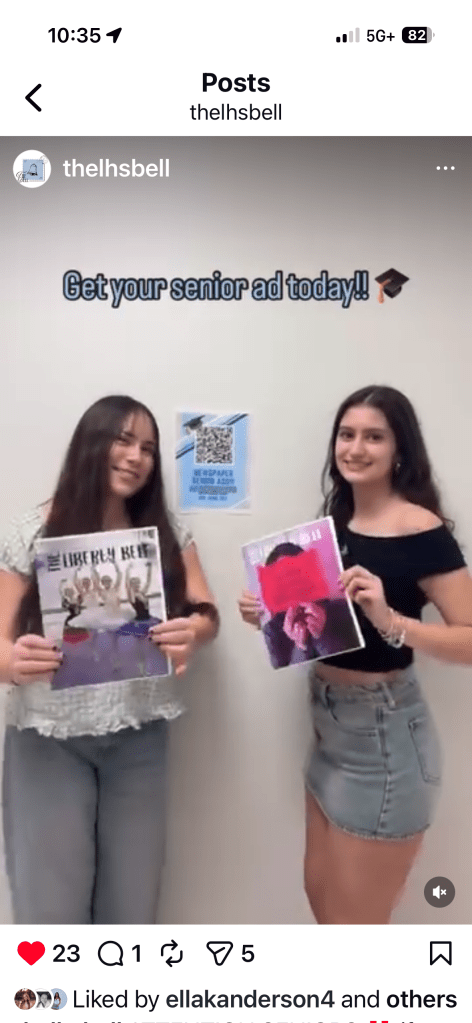
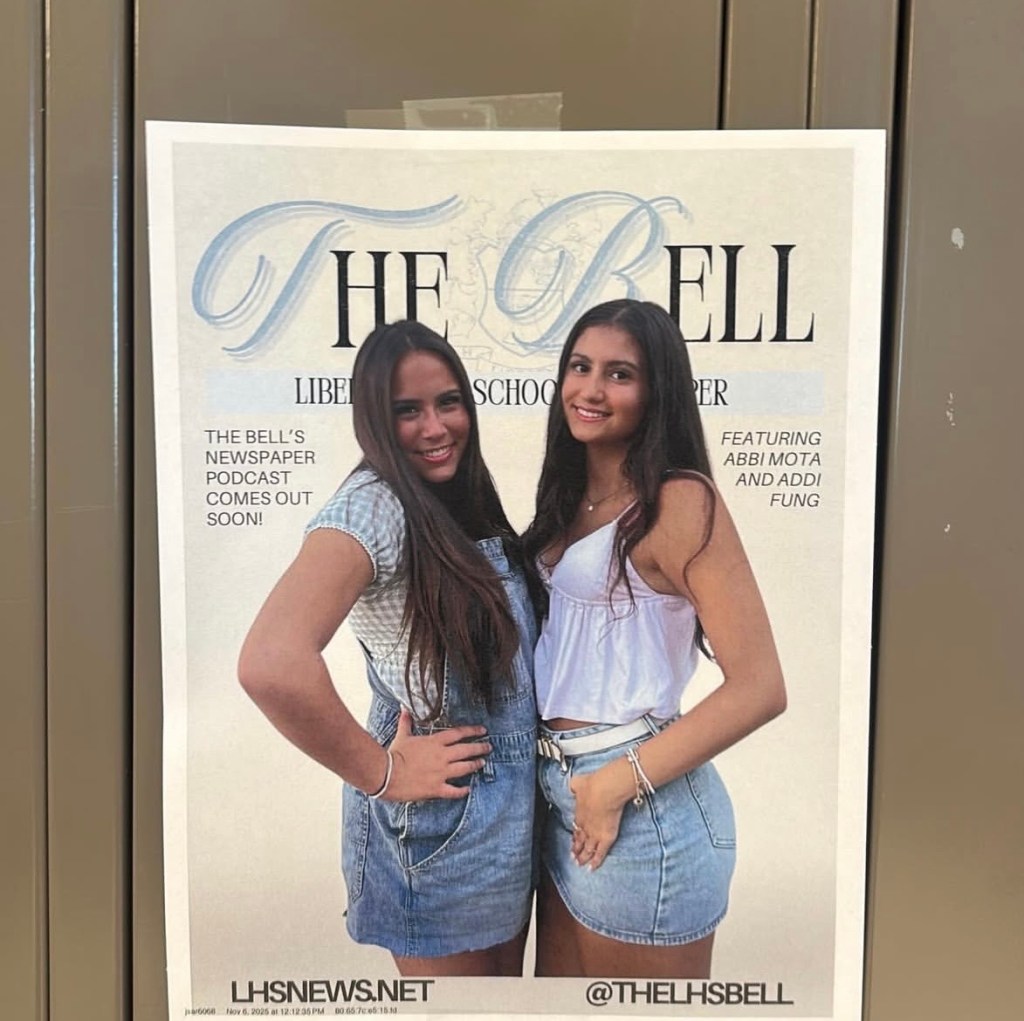
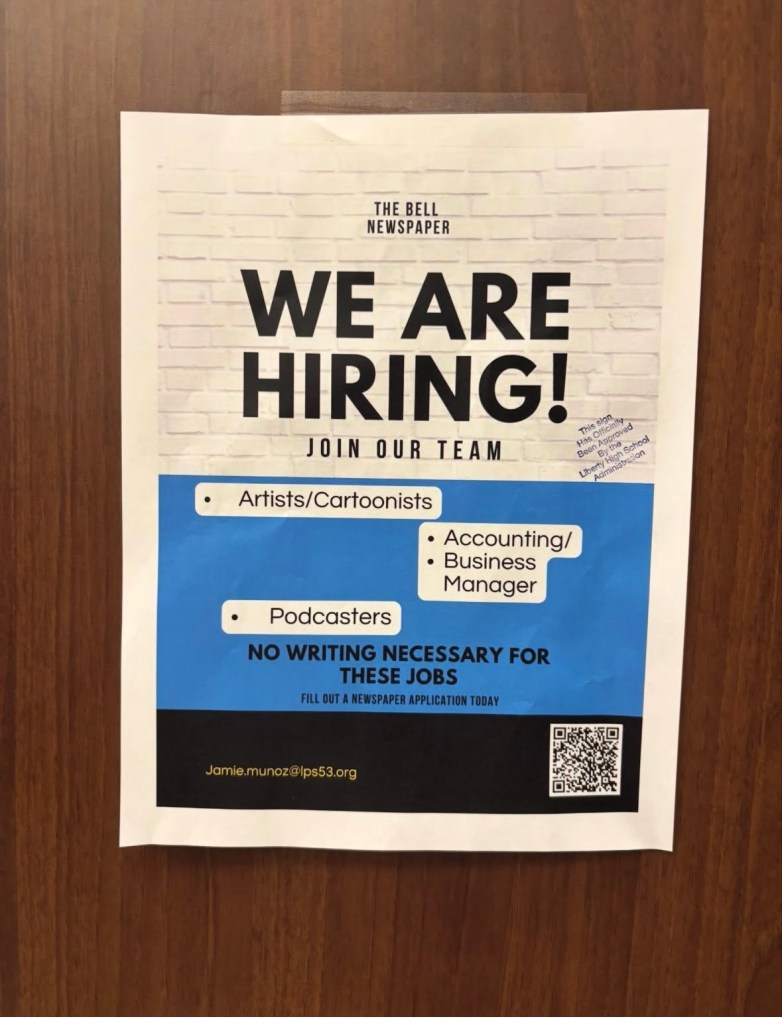
In our class, it is our job to market our issues, senior celebrations and the class itself. As we are a school paper, our audience is mostly high school-age students, with the exception of parents and teachers. That being said, we use social media as the main way to market and connect to our audience. Here, our social media manager promotes our latest issues and podcasts. We also have hung fliers around the school for encouragement to buy senior celebrations. Speaking of senior celebrations, I have also worked a table during parent teacher confference,s so parents will stop by and buy a senior celebration for the student to be featured in our senior issue. I have also worked tables during our school’s academic fairs to encourage more students to join our class and build our staff.
Social media post promoting our issue and senior celebrations.
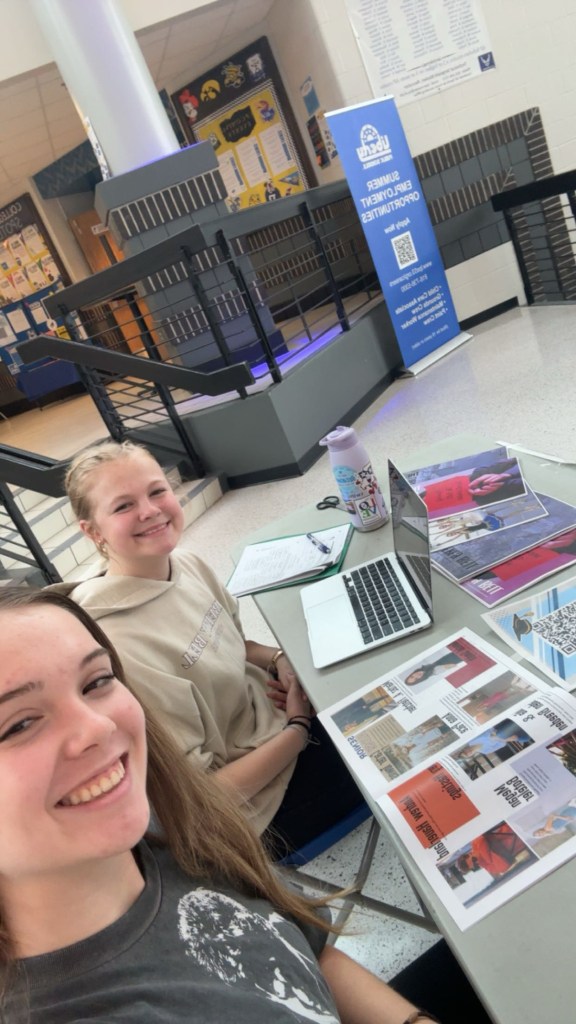
Selling senior celebrations at a parent-teacher conference.
A table at the academic fair promoting our class.
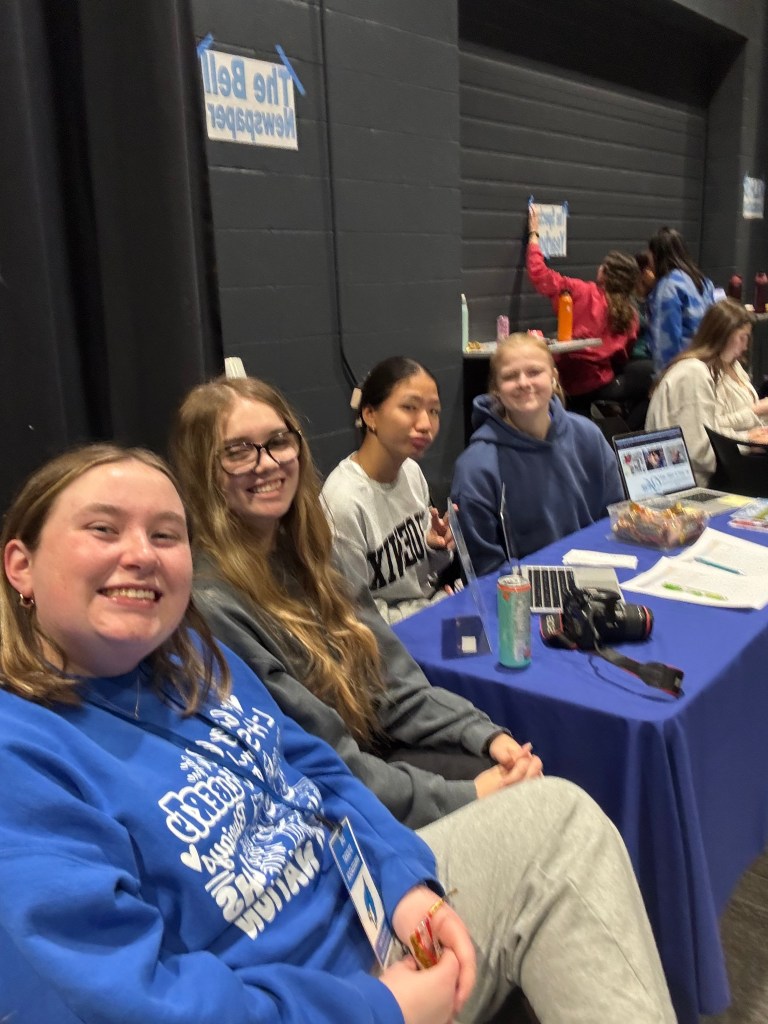
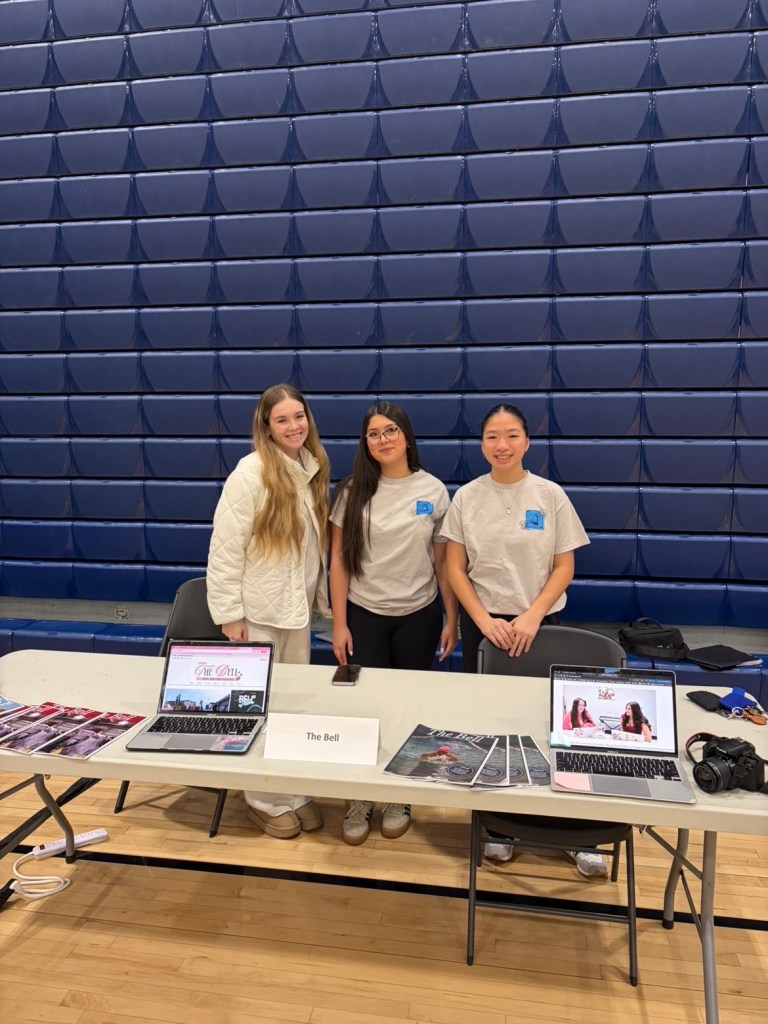
Table at the middle school shadow day to promote our work and class.
Posters around the school.
Commitment to Diversity
It is our mission to try to get every student in our paper by the end of the year, meaning we must cover a variety of people and stories. We also focus on gender equality by spotlighting one boy and one girl each issue while swaping between freshman and junior, and sophomore and senior. This also helps us get a variety of grades in our paper. It is also my job as EIC to decide what story ideas we follow through with. I take into account diversity and unique subjects that aren’t usually talked about or covered. This year, we have done stories on topics such as horseback riding, boxing, pagentry, foreign exchange and Black History Month.
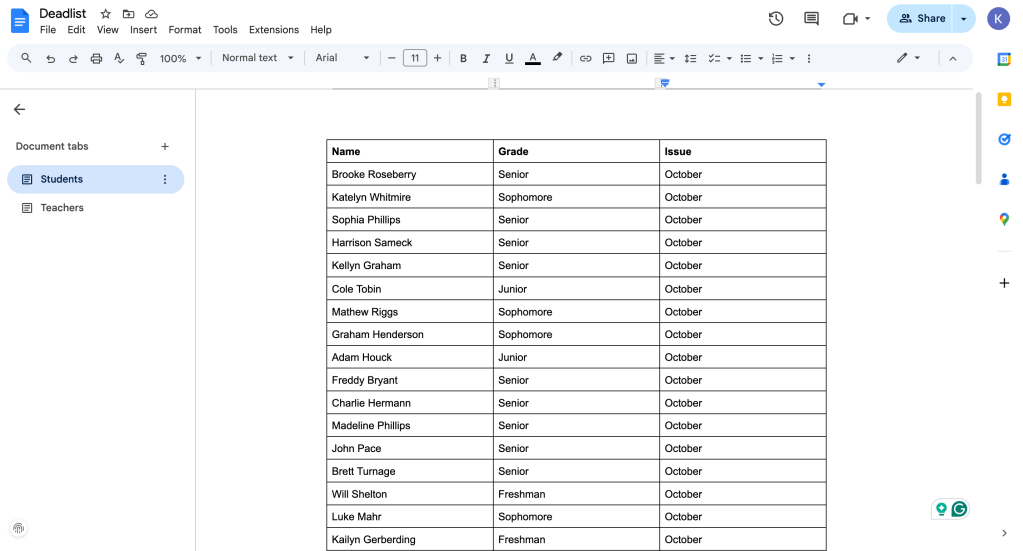
Above is a part of our “deadlist” where we keep track of the people we used and their grades, so we can focus on getting different grades and make sure that we don’t use the same person twice.
Above is my design on student who is an immigrant from Peru. The story was already over student and angle that isn’t usually covered, so I took it upon myself to expand on that. I decided to have my mod over other students with spanish hertiage to cover more students of this background.
Address
Contact
Designed with WordPress
 Kora Smith